By CHIOMA OBINNA
Chinyere Okoye was there that fateful morning her senior sister bled to death while giving birth her 7th child. Ever since, Chinyere, a mother of two, never thought of going back to the labour room. She had wanted to have as many babies as possible before the incident. Now that she had resolved to put a stop to child bearing, she has been faced with bigger problems.
At 32, Chinyere, considers herself fertile. She believes she needs no soothsayer to tell her that she can still bear children. Although, she was determined to control her fertility but she could not do so as she has no access to information on modern birth control methods. As a result, Chinyere and her husband resorted to the age- long method known as “Withdrawal” which is never 100 per cent reliable.
Over time, Chinyere has continued to fight this problem ignorantly without the right information. In the space of one year, she had undergone three abortions. Alas, after the last one, her doctor had warned that any further attempt would be a risk to her life. But, today, Chinyere is pregnant with her fourth child.
Ope’s experience was one that she would live to remember. For her, traveling that path again, after an unsafe abortion may mean sending her to her early grave. According to Ope, with the right information from a family planning department of one the Primary Health care centres, (PHCs) she is now on the birth control pill. To Ope, she is now in control of her own fertility.
For 37 -year -old Angela, a journalist by profession, life has been what it should be for her as a mother and professional. This, she attributes to the power of understanding the birth control.
If Angela, who married at a tender age was not informed about controlling her fertility, she would have had more than three children today.
Angela who had her third baby at the age of 25 due to the quick succession at which they babies came would have still be having babies till now.
However, many Nigerian women have not been so fortunate to receive or to access the right information regarding birth control apparently, due to so many controversies surrounding birth control.
The practice of birth control or preventing pregnancy is as old as human existence. For centuries, humans have relied upon their imagination to avoid pregnancy.
Today, the voluntary control of fertility is of paramount importance to modern society. From a global perspective, countries currently face the crisis of rapid growth of the human population that has begun to threaten human survival. According to the Population Reference Bureau’s 2003 World Population Data Sheet, the world’s current growth rate is 1.3 per cent. Based on this growth rate, the population would double in 53.8 years. The less developed world’s natural increase rate (births minus deaths, without migration) is 1.6 per cent; therefore, population in these countries would double in 43.8 years.
Today, Nigeria has one of the highest maternal mortality rates in the world and this has been attributed to the inability of Nigerian women to adequately use contraceptives to assist them in successfully spacing of their children.
According to the Permanent Secretary of the Lagos State Ministry of Health, Dr. Femi Olugbile, the statistics depicting the maternal and child health status in Nigeria are not cheering, even though it represents an improvement from the past.
The National Demographic Health Survey (NDHS) 2008 puts the Maternal Mortality Rate at 545/100,000 live births. Statistics available have shown that only 10 to 11 per cent of Nigerians use any form of modern family planning method. Experts say this portend serous danger, as studies carried out in Nigeria shows that large percentage of Nigerian youths are sexually active.
In 1988 and 2001, the Federal government of Nigeria adopted the National Population Policy and National Reproductive Health Policy, respectively, both of which seek to achieve quality reproductive and sexual health for all Nigerians. The policies were developed to address the unacceptable rate of maternal and infant morbidity and mortality in Nigeria in addition to the relating lack of awareness and utilsation of family planning services. The policy also sought to ensure that every man and woman has the opportunity to obtain and use any contraceptives of their choice “at the right place, at the right time, and at the right cost.
Unfortunately, after the enactment of these policies, the issues, particularly, the use of contraceptives have remained a great concern.
According to Executive Director of Ipas, Dr. Ejike Oji, the rampant cases of unwanted pregnancies with the attendant high rate of abortion, mostly unsafe could fuel the maternal mortality rate.
Oji was also of the view that improved level of acceptance of contraception as an intervention that could effectively improve maternal health and reduce the number of women dying from pregnancy related causes would in turn reduce the rate of maternal mortality in Nigeria.
Studies have shown that lack of child spacing leads to a lot of unplanned pregnancies which results in abortions or worse deaths during child birth. According to them, the health risks of using contraceptives are much less than the risks of unwanted pregnancy and childbearing for almost all women, especially in countries with high maternal mortality rates like Nigeria
But contraceptives help in preserving the lives of women, says Bright Ekweremadu, Managing Director, Society for Family Health (SFH).
Nigeria has continued to struggle with accepting old methods of contraception as means of family planning causing the country to record uncontrolled deaths from incidences relating to unwanted pregnancies and child birth.
However, for the individual woman, the effective ability to control when and whether she becomes pregnant affects her ability to achieve her own goals and contribute to her sense of well-being. A woman’s choice of birth control method involves factors such as how easy it is to use, safety, risks, cost, and personal considerations.
Birth Control
How to decide According to experts, with so many options, choosing a form of birth control can be daunting. However, they say beginning with a few questions like: Do you need to protect against STDs? How important are convenience and cost? What about effectiveness?
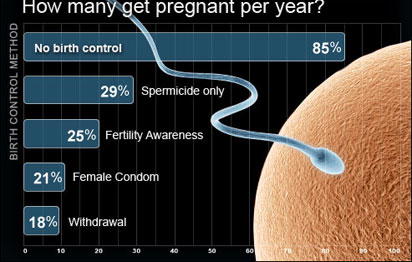
Only abstinence is 100 per cent effective, but other methods come close as our effectiveness chart shows in a glance. It is also necessary for individuals to ask their doctors which options are best for them.
Fertility awareness: Also called natural family planning, fertility awareness means avoiding sex when the woman is most fertile. The most reliable way to do this is to watch for changes in cervical mucus and body temperature. To use this method correctly, it’s best to get training from a health care professional.
Spermicide: Spermicide contains a chemical that kills sperm. It comes in the form of foam, jelly, cream, or film that is placed inside the vagina before sex. Some types must be put in place 30 minutes ahead of time. Frequent use may cause tissue irritation, increasing the risk of infections and STDs. Spermicides are most often used along with other birth control methods.
Female condom: The female condom is a thin plastic pouch that lines the vagina and can be put in place up to 8 hours before sex. Users grasp a flexible, plastic ring at the closed end to guide it into position. It’s somewhat less effective than the male condom. It is widely available, protects against STDs, conducts body heat better than a male condom but can be noisy, 21 percent of users get pregnant, not reusable. Should not be used with a male condom, to avoid breakage.
Cervical cap: A cervical cap is similar to a diaphragm, but smaller. The FemCap slips into place over the cervix, blocking entry into the uterus. It is used with spermicide. The failure rate for the cervical cap is 15 per cent for women who have never had children and 30 percent for those who have.
Birth control sponge: The birth control sponge, is made of foam and contains spermicide. It is placed against the cervix up to 24 hours before sex. The sponge is about as effective as the cervical cap. But unlike the diaphragm or cervical cap, no fitting by a doctor is required.
Birth control pill: The most common type of birth control pill uses the hormones estrogen and progestin to prevent ovulation. When taken on schedule, the pill is highly effective. About 8 per cent of typical users get pregnant, including those who miss doses. Like all hormonal contraceptives, the pill requires a prescription.
Vaginal ring: It is a soft plastic ring that is worn inside the vagina. The ring releases the same hormones as the pill and patch and is just as effective. But it only needs to be replaced once a month.
Birth control shot: The birth control shot, known as Depo-Provera, is a hormonal injection that protects against pregnancy for three months. For the typical couple, it is more effective than the birth control pill – only 3 per cent of users get pregnant in a year.
Birth control implant: The birth control implant (Implanon) is a matchstick-sized rod that is placed under the skin of the upper arm. It releases the same hormone that’s in the birth control shot, but the implant protects against pregnancy for three years. The failure rate is less than 1 per cent.
Intrauterine device (IUD): IUD, a T_shaped piece of plastic that is placed inside the uterus by a doctor. The copper IUD, ParaGard, works for as long as 12 years. The hormonal IUD, Mirena, must be replaced after 5 years. Both types make it more difficult for sperm to fertilize the egg. Fewer than eight in 1,000 women get pregnant.
Tubal implants: A newer procedure makes it possible to block the fallopian tubes without surgery. Small implants of metal or silicone are placed inside each tube. Scar tissue eventually grows around the implants and blocks the tubes. Once an X_ray confirms the tubes are blocked, no other form of birth control is needed.
Diaphragm: The diaphragm is a rubber dome that is placed over the cervix before sex. It is used with a spermicide. Effectiveness compares to the male condom – 16 per cent of average users get pregnant, including those who don’t use the device correctly every time.
Birth control implant: The birth control implant (Implanon) is a matchstick-sized rod that is placed under the skin of the upper arm. It releases the same hormone that’s in the birth control shot, but the implant protects against pregnancy for 3 years. The failure rate is less than 1 per cent.
Tubal ligation: If you are sure you won’t want biological children in the future, you may be ready for permanent birth control. The traditional method for women is called tubal ligation or “having your tubes tied.” A surgeon closes off the fallopian tubes, preventing eggs from making their journey out of the ovaries.
Vasectomy: Besides condoms, a vasectomy is the only birth control option available to men. It involves surgically closing the vas deferens – the tubes that carry sperm from the testes, through the reproductive system. This prevents the release of sperm but doesn’t interfere with ejaculation.
Birth control patch: Women who have trouble remembering a daily pill may want to consider the birth control patch. The Ortho Evra patch is worn on the skin and changed only once a week for three weeks with a fourth week that is patch-free. The patch releases the same types of hormones as the birth control pill and is just as effective.
Withdrawal: This is the age-old method that relies on the man withdrawing his penis from the vagina before ejaculation. Newer reviews show that when it’s done correctly every time, about 4 per cent of users get pregnant in a year. With more typical use, about 18 per cent get pregnant.
Options for older women: Age and lifestyle are important factors in choosing a form of birth control. If you’re over age 35 and smoke or are obese, the combination birth control pill, patch, and ring are not recommended. It is best to consult your doctor about safe alternatives. If you’re approaching the age of menopause, the birth control shot has an added benefit: It may relieve some of the symptoms of perimenopause.
Least Effective Methods: Without using any form of birth control, 85 per cent of sexually active couples will get pregnant within a year. Even the least effective birth control options reduce that number considerably.
Most Effective Methods: Although barrier methods, such as the condom or diaphragm, are moderately effective with typical patterns of use, hormonal contraceptives have a better track record for effectiveness. There are also several options for couples that prefer the lowest possible odds of getting pregnant. Two of these are reversible – the IUD and hormonal implant. Of course, the only birth control method that is 100 per cent effective is abstinence.
Disclaimer
Comments expressed here do not reflect the opinions of Vanguard newspapers or any employee thereof.