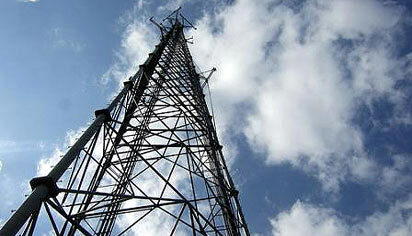
Telecom mast
*SMEs lament: Our livelihood goes with poor network connections
•Nigeria recorded over 5,000 fibre-optic cuts in six months – NCC
•Telcos blame fiber cuts, vandalism, power
By Juliet Umeh
For Nigeria’s growing army of internet-reliant entrepreneurs and workers, the network bars on a mobile phone can mean the difference between earning a living and going home empty-handed.
For an online seller, a lost connection can mean a missed order; for a ride-hailing driver, a missed trip; for a POS operator, a failed transaction; and for an online tutor, a disrupted class.
Increasingly, the internet is no longer just a tool for communication. For millions of workers and small businesses, it has become the marketplace, payment channel, classroom, dispatch system and customer-service desk.
But when the connection disappears, so does the livelihood built around it.
For Mrs Anna Nso, a small business centre owner in Aba, Abia State, a poor network has become a daily battle with frustrated customers, financial losses and mounting anxiety.
One day, a network glitch turned a routine electricity payment into a costly mistake.
“My husband wanted to recharge N1,900 electricity bill for a customer, but because of the network problem, he mistakenly recharged N19,000,” Nso told Vanguard.
“The network stressed him so much that he made the mistake.”
It was not an isolated incident.
“There are times we transfer money twice because we don’t know the first transfer has gone through. If you don’t check the transaction history before trying again, you can end up making a double transfer,” she said.
The pressure is compounded when customers crowd her shop waiting for transactions to go through.
“You discover that customers will line up in the shop, waiting for me to attend to them. In the process, I will be turning my phone up and down, moving from one corner to another in search of a network,” she said.
The stress has also begun to take a toll.
“I recently checked my BP because I was having constant headaches and feeling dizzy. My nurse told me it was 150 over 100. Honestly, I wasn’t surprised. The challenge I face in my shop every day is enough to give someone a headache,” she said.
‘If I’m unreachable, I can’t earn’
For e-hailing driver Polycarp Dawalere, poor network can mean the difference between receiving an order and going home empty-handed.
The Taraba State indigene, who formerly lived in Ikorodu, Lagos, said unstable connectivity had become a familiar frustration.
“We do have problems with the network, especially in some places in Ikorodu. The network is always very poor in so many areas,” he said.
Dawalere depends on digital platforms for his livelihood.
“If I am in a place where the network is bad, I can’t get any order because I will be unreachable,” he said.
The problem became so serious that it influenced where he lived.
“This was the major reason I left Ikorodu. I noticed I was losing clients,” he said.
For him, the equation is simple:
“If I am unreachable, I cannot get an order. And if I cannot get an order, I cannot earn.”
‘A one-hour class can stretch to 90 minutes’
For Debbie Ntigeli, an online tutor in Ajah, Lagos, unstable connectivity can turn a one-hour lesson into a 90-minute struggle.
“With how unstable some of the network providers have been lately, I sometimes experience network delays and disconnections, which interrupt the flow of the lesson,” she said.
“It also affects my ability to share learning materials and use interactive tools with my learners.”
Sometimes she has to move around her environment searching for a stronger signal.
“A class that is supposed to last for one hour can sometimes extend to an hour and 30 minutes because of time lost to network interruptions,” she said.
The cost of staying connected also comes directly from her pocket.
“I spend about N25,000 monthly on data. Data is one of my major teaching-related expenses,” she said.
For Ntigeli, connectivity is therefore not an optional expenditure. It is part of the cost of earning an income.
When the shop lives on a phone
For Lagos fashion entrepreneur Tomiwa Ibukunle, the vulnerability of an online business became clear during the global WhatsApp, Facebook and Instagram outage in October 2021.
On an ordinary day, WhatsApp Business brought her about 20 orders.
But when the platforms went down, she received only five.
For an entrepreneur whose shop largely exists on a smartphone screen, the lesson was painful:
When connectivity disappears, the shop can disappear with it.
Another fashion seller, Dolapo, initially thought her own network was responsible when messages and calls stopped working.
Then she realised: “WhatsApp was down.”
For her, the platform was her enquiry desk, order channel and customer-service platform.
A similar experience confronted Lagos fashion vendor Adaeze Nathan during an Instagram outage in 2026.
When messages stopped sending, she discovered that the problem was not her internet connection but the platform itself.
The experiences expose a new vulnerability for Nigeria’s small businesses. For entrepreneurs whose storefronts, customer relationships and payment channels exist largely online, connectivity is no longer a convenience. It is infrastructure.
The infrastructure behind the disappearing bars
Behind these individual experiences is a larger infrastructure challenge.
The Nigerian Communications Commission, NCC, disclosed that more than 5,000 fibre-optic cut incidents were recorded in the first six months of 2026, largely linked to road construction, excavation and other civil works.
NCC Executive Vice Chairman, Dr Aminu Maida, warned that the damage goes beyond the cables.
“To a machine operator on a construction site, it may appear to be a simple buried cable. To the nation, it can mean failed calls, delayed payments, interrupted services and missed opportunities,” Maida said.
He stressed that Nigeria must build roads while protecting the fibre networks that connect the economy.
The scale of Nigeria’s digital dependence is reflected in data consumption. NCC figures show that Nigerians consumed more than 1.5 million terabytes of data in May 2026, rising to about 1.53 million TB in June.
Industry raises alarm
The telecom industry says the problem is compounded by vandalism, inadequate infrastructure and other operational challenges.
The Association of Licensed Telecom Operators of Nigeria, ALTON, said network sabotage and vandalism, including stolen fibre cables and base-station equipment, continue to degrade connectivity.
Its Chairman, Engr Gbenga Adebayo, said such incidents affect millions of subscribers.
The Association of Telecommunications Companies of Nigeria, ATCON, also identified inadequate last-mile connectivity and limited fibre penetration as challenges, particularly in underserved areas.
MTN Nigeria said it experiences between 35 and 40 fibre cuts daily across the country, arising from road construction, vandalism, sabotage and other factors.
The company also disclosed that an average of one to two telecom sites are vandalised every day, with generators, batteries, solar equipment and other critical infrastructure stolen or damaged.
In 2025 alone, MTN recorded 452 incidents of site vandalism, according to its General Manager, Network Services, Asura Mshelia.
He warned that repeated attacks could make further investment in affected locations difficult to justify.
Power: the other side
Even where fibre infrastructure remains intact, electricity remains a threat to network reliability.
Airtel Africa Chief Executive Officer, Sunil Taldar, said inadequate power supply was one of the biggest challenges facing telecom operators in Nigeria.
“To compensate for non-availability of power, what do mobile operators do? We run most of our sites through diesel,” he said.
“So, what we’re doing is we are delivering a network, but we are also becoming power generators. Now, that’s not our core job.”
Taldar said diesel-powered sites cost almost four times more to operate than those running on grid electricity.
He also warned that when telecom networks go down, the impact extends beyond telecommunications.
“Each time when a telecom network comes down, it’s not only the telecom network which is coming down in a particular area, it’s part of the economy which is coming down,” he said.
For Nso, however, the issue is far simpler than fibre routes, vandalism, power supply or broadband targets. What matters to her are the customers waiting in her shop, the transactions that need to be completed and the money that needs to be transferred.
Whenever the signal disappears, she moves from one corner of her shop to another, raises her phone and waits, hoping to find a stronger connection. Sometimes the transaction goes through, sometimes it fails, and at other times she is left wondering whether making another attempt could create a second problem.
For people like Nso, Dawalere, Ntigeli and thousands of other Nigerians whose livelihoods increasingly depend on digital connectivity, “network problem” is no longer merely a telecommunications complaint. It has become a business problem, an income problem and, increasingly, a livelihood problem.
When the network disappears, therefore, the question is no longer simply whether someone can browse the internet. It is whether they can work, sell, teach and earn a living.
Disclaimer
Comments expressed here do not reflect the opinions of Vanguard newspapers or any employee thereof.